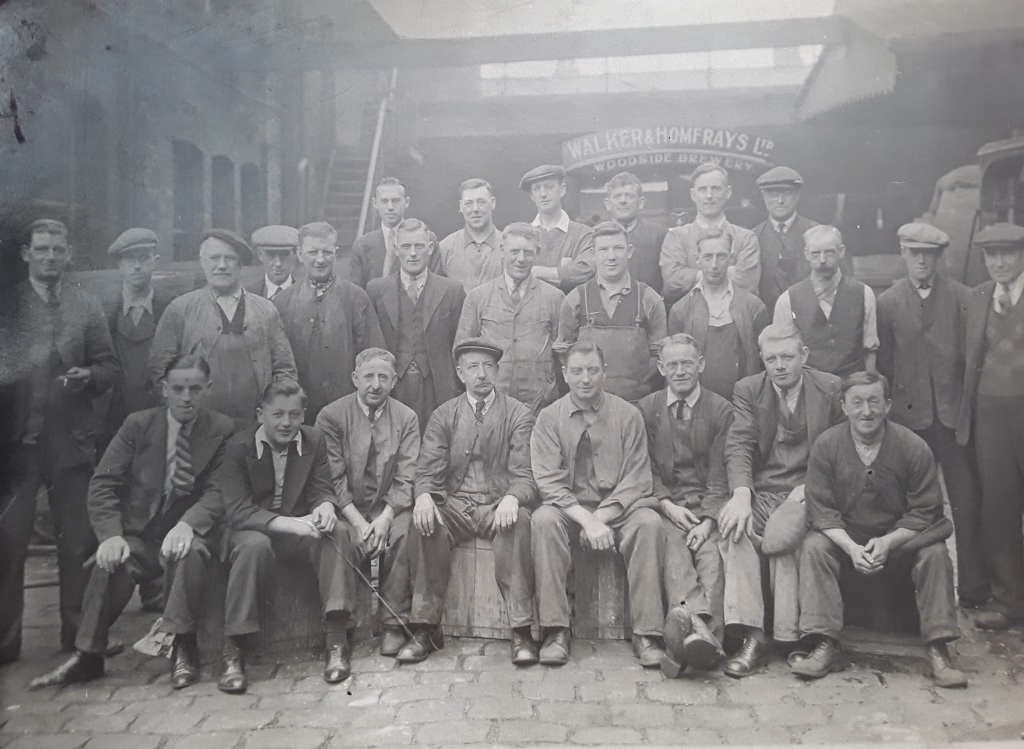
Chapter 1: The crew and friends
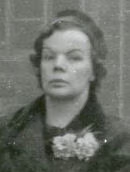
To be different, I will begin my story at the middle of my life. If this pleases my readers they may even wish to know how it began, and that would please me quite a lot.
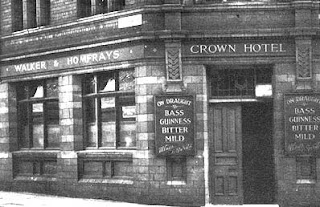
It was 1940 and our country was at war with Germany. I was employed by Walker and Homfrey’s Brewery – a pleasant job for a good firm. The licensee, his wife and staff all got on together very well. We were, in fact, a very happy crew. The customers had always been nice, but in 1940 they became fantastic – what is there about war that brings out the best in people? Well it brings out the best in British people. Could it be the spirit of chivalry raising within us, could it be deep rooted patriotism, or could it be the self preserving thought, “I must be good today, I might die tomorrow”. A sort of anxious hope to reserve a seat in Heaven? I wonder if that would work? My seat in Heaven is reserved I know, and it is a lovely feeling, but that happens later in my story.
I had a young man named Ritchie. They were not called ‘boy friends’ until a little later. He was not the proverbial tall, dark and handsome hero, in fact he was short and blond. He was an absolute ‘dead riinger’ (that’s 1940 slang) for Spencer Tracey the American film star. He laughed like him too, and for some unaccountable reason Ritchie seemed to find me amusing. When I asked why the answer was another chuckle, so I left it at that. He was never bossy and I was content. Like my job and liike by life, my love was pleasant and easy going.
Once I caught a glimpse of inner depths. We had planned to meet at Southport. Ritchie, who lived in Birkdale, was to meet the train at Lord Street Station. The train was late and crowded with holiday people. I bobbed about trying to get through them, but my five feet two inches figure, backed by seven and a half stones weight, hadn’t got a chance. I saw him standiing there but he hadn’t seen me. Oh dear, he wasn’t short, plump and blonde. He was little, fat and miserable. “Oh Lord shall I get in the train and go back”, I thought – then – “Oh to heck with it. You are here, make the best of it”. So I pushed forward and when I was near the barrier, he saw me. What a transformation! His green eyes glowed like emeralds, even his hair looked a brighter gold and his face and smile outshone the sun. Three passengers near him stopped in their tracks, looked him over and then looked back in the direction Ritchie was looking. I slipped back into the crowd. When I eventually reached him he was the Ritchie I knew, perfectly groomed, beautifully tailored, down to earth and slightly bemused. Silently I vowed to myself never to be late again. Let sleeping genies lie, no matter how beautiful their eyes look. The calm clear waters were so comfortable and so me. I believed that, I really believed it, so I decided it would be better if Ritchie came to Bolton where I could waiit, quiet and unruffled for him. And so it was arranged.
The hotel was extremely busy but we always had time for our customers. And why not? Without them we were useless. I think of Turps, tallish, thin and deathly pale. Before the war he was an iinterior painter and decorator. The bane of his business, the bane of his life, the bane of his conversation was the cost of Turps. He was more upset by the cost of turps than the cost of beer and the government then (as now) slapped more and more taxes on beer at every budget, so of course I christened him Turps. I can’t remember his name at all now. The evening he came in to tell us he had been posted was one I will never forget. He said he was fully trained and moving on. I asked, “Where to?”.
“I can’t tell you that, Sheila. For all I know you could be a Russian sply. I always thought you looked a bit strange anyway.”
“Well Turps, we can’t all be painters and decorators and look life you”.
“By Hell, Sheila, you should see the recruits that come in a few weeks ago. They looked like nothing on Earth. Sarge said we looked like them a couple of month ago but we could NEVER have looked like that”.
“Of course not love, it’s the flick of the wrist with the paint brushes that makes the difference”.
“Joking apart Sheila, they are a right bunch. They had to wear their own clothes at the start, like we ‘ad – a lot of ’em had pork pie hats, bell bottomed trousers and nipped in waists. They looked live bloody Spivs.”
“Hello Turps. Hallo Mrs”.
The licencee’s wife Doris came to our end of the bar. “Glad to see you. How is the army treating you?”
“Oh we’re moving on Mrs. I was telling Sheila I’ve finished my training”.
“We’ll miss you Turps, we really will”.
“The new recruits won’t miss from what he’s told me”.
“Listen to her Mrs – eh. Sheila don’t be hard love, you ‘aven’t seen ’em – All right, so they had stabs – so did we. Our arms were used like bloody pin ushions. Tell you what they felt like – they felt like the gum feels when you get the needle before your tooth is pulled. Sarge has you marching up and down yelling, ‘Swing those arms’ “.
“You can’t swing your arms, Sheila, they’re paining like hell and they’re as still as iron bars. Then you spot the seargant walking towards you with murder in his eyes, and you swing your arms by hell – how you swiing ’em”.
By now Turps was marching up and down the passage in front of the saloon bar, pulling the most horrific faces at every step. The chaps in the vault were laughing uproariously as they watched over the bar. I got the feeling that some of them were remembering their own training days. So did Turps apparently. He put his head under the bar window to look across at the lads in the vault.
“I bet many of you know what it’s like”, he said, “You can’t sleep on your right side, you can’t sleep on your left side and when you sleep on your back, some bugger wakes you up and thumps you ‘cos you’re snoring. Reckon I’d better get off and win this war, then we can all get some sleep. Bye fellows, bye Mrs. Bye Sheila – bye Dolly – bye Gilbert”.
“Bye Turps”.
He couldn’t take a bottle, he kept all the rules. We wanted to shower him with cigarettes. Trust Turps to be a non-smoker. II moved on and didn’t see him again. Dear gentle Turps, I hope you fared well. At this point I would like you to meet Dolly. Dolly didn’t live in the hotel. She camme early in the morning, went home 2.00 p.m. or 3.00 p.m. and returned around 7.00 p.m. and worked until we finished. She had a husband, two daughters and one grandchild. They had a very large house owned by the GReenhall Brewery and let to them at a nominal rent in exchange for looking after two dray houses they had retired. The Breweries are not the noes with the profits, they are the ones with the hearts. The government gets the profits.Dolly was a Cockney. She was very tiny, built like a whippet and could move as fast as one. Her face was small and impish with round, dark brown eyes. to see her work was educational. It’s not only the ants that can carry their own weight. Dolly could. To use a 1940 expression, Dolly was ‘fond of the opposite sex’, so the Boss called her Clea, (short I thni for Cleopatra). One terribly busy night two strangers came in and heard the regulars calling their orders to her, but they got her name wrong.
“Two pints here, Leo,” they shouted.
Dolly was at the pumps. She had ten pint pots on a tray that she was filling with beer. She stopped for a second, raised a flushed face, and her Cockney voice gasped out –
“LEO? What do you think I am, a bleeding lion?”
That was our dolly – a character if ever there was one. She had an amazing capacity for a four foot ten inch ‘Twiggy’. We didn’t drink on duty so when told “and one for yourself, Dolly”, she took a Baby Guiness off the shelves and put it on the show case at the end of the bar. By closing time there could be ten or sixteen bottle there.
After the glasses were washed, polished and put away Dolly would open her first bottle. Our two waiters could drink on duty, so they preferred Mrs. Doris and me to include them in our ‘tea party’. Meanwhile Dolly was opening the bottles. One after the other, and drinking them. I’m sure if the customers knew she did this they would have brought her twice as many, just for devilment. When the last bottle was empty Dolly would rake the fires in all the rooms, making them safe for the night, empty the ashtrays, wash them and then upend the chairs onto the seating or tables in all the rooms, ready for her to start the next morning. Thn she would go home sober as a judge. I will rephase that – she would go home sober as a teetotler. As I said, our Dolly was a character.
The boss, Mr D – was a bit of a dandy, a bit of an extrovert, a bit of a boaster too. The bit has nothing to do with the fact that he was approxiamtely five foot five inchers tall. The bit meant that he started much but achieved nothing. One of lifes rather useless charmers, or should I say – a bit of a charmer.
Bob, the older waiter, tuaght us the pleasure of greyhound racing. We never won but it was such fun weighing up form, picking winners and then waiting for results.
We really were a happy crew. It was hard work and time consuming but it was so satifying, so rewarding. Our customers were our friends, we were actually fond of them. With three exceptions on my part. Maybe the others had one or two exceptions also, but that still isn’t a lot. Not really.
The days were passing more quickly as the war progressed. More and more of our friends exchanged their civilian clothes for uniforms and more strangers replaced them.We sympathised with Cowboy when he volunteered. Cowboy was a quiet, dignified family man. He had the sort of eyes that could see in the dark. I don’t mean he was an albino. That he certainly was not. He was a rosy faced little chap with black hair. Becuase of his sight, he had been the night driver for a well known taxi firm for over seventeen years. He was as clever with the a car on icebound roads as Torvil and Dean are with skates on a rink. All that talent was completely aborted by the army. The army appealed for night drivers, and they appealed for night drivers, the appeal was compelling and dramatic, and it stirred the patriotism in Cowboy’s heart, so he volunteered. A sad and wiser family man came to tell us the army had trained him – as a cook. They knew he was a volunteer, they knew he was a very able nightdriver, but: “We make the decisions around here – cook house for you”. We said “Fairwell” to a slightly dejected, very puzzled volunteer.The greatest puzzle of all is how we ever managed to win the war at all. I believe it was because God supported us, Churchill guided us, our ryal family inspired us, and the British people just refused to loose.